
Sumba is one of those places that you should visit at least once in a lifetime. With its untouched beaches, green rolling hills, extensive savannas, and wild horses, Sumba is undoubtedly a paradise waiting to be explored. And, of course, there is more to the island than what nature has bequeathed, the Sumba culture.
So, it’s no surprise that visiting local villages seems to be popular among visitors, as it allows you to get an insight into their fascinating culture. While Christianity is the dominant religion on the island, some Sumba people still adhere to Marapu beliefs with its centuries-old traditions that have been passed down through the generations.
Read on to dive into this ancient religion so you have a bit more knowledge about the unspoilt island before you visit!
Marapu: Sumba’s Traditional Culture
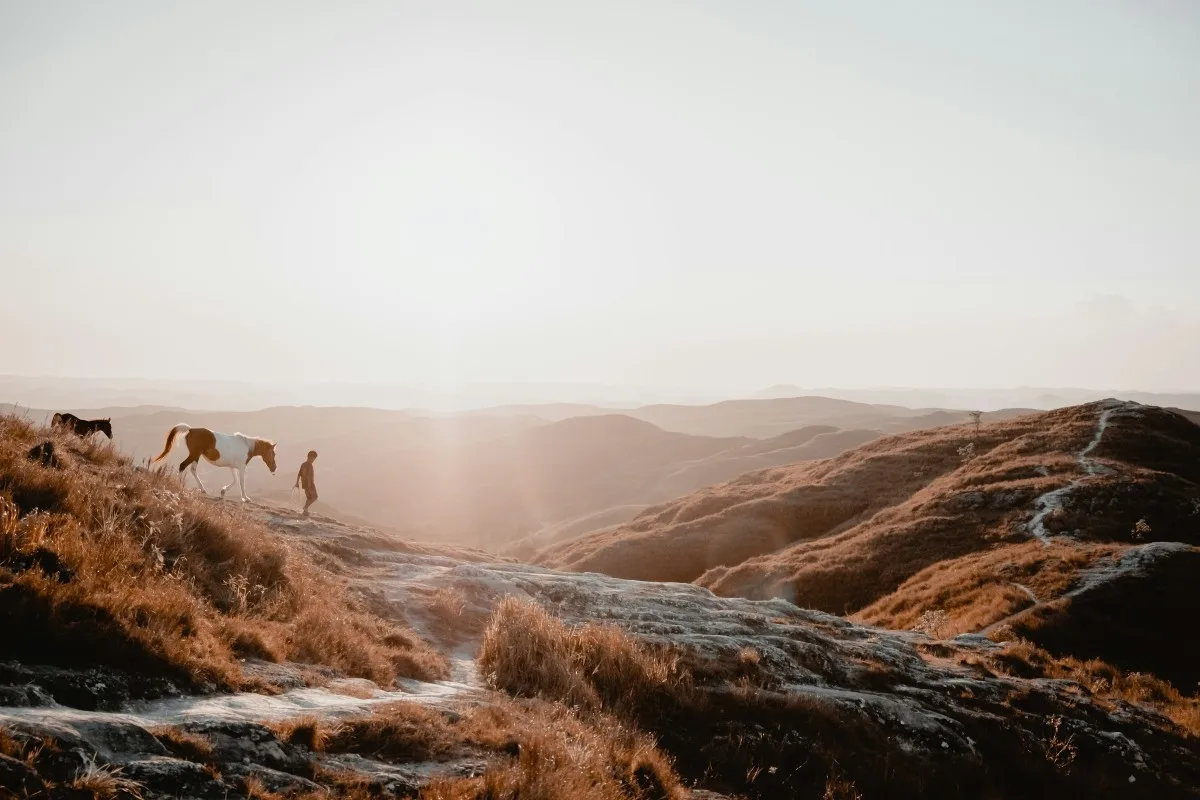
Photo: Febiyan via Unsplash
Beyond the island’s wild beauty, Marapu is one of the most incredible wonders you can find in Sumba. Marapu is a belief system that has been around for thousands of years, before the arrival of major religions like Christianity on the island, even before Indonesia was established.
The locals pay obeisance to the spirits of the dead who act as intermediaries between the living and the divine realm. In the Sumbanese language, those spirits are called Marapu, which means “the revered” or “the lord” that governs human life, and that’s how Marapu got its name.
They believe that their ancestral spirits provide power, spiritual guidance, peace, safety, and security. From the moment you arrive, you can see that this ancient belief is deeply rooted in Sumba traditions.
Traditional houses, birth-to-death rituals, megalithic tombs, as well as sacred symbols–evidence of the presence of this Sumba culture can still be found today. These practices are intended to appease the deities or ancestors and protect the sacredness of nature. And, thus, it creates a harmonious relationship between humans, nature, and the spirits.
Being a minority in a country laden with the world’s major religions, Marapu did struggle to be recognized and live to this day. Mostly for administrative recognition, like marriage and birth certificates, they had no choice but to convert to official religions.
Even so, the Marapu people manage to live in harmony and peace with other religious groups like Christian and Muslims. Take this as an example, they often attend Christian services and give offerings as they believe it will not interfere with their belief.
And, of course, the wait finally paid off. With the Constitutional Court’s decision in 2016, Marapu is taught as a subject in schools. They also engage in various revitalization activities, including language preservation, discussions, workshops, and cultural performances.
Also read: The Ultimate Guide to Surfing in Sumba: Discover the Perfect Waves
Marapu Rituals & Ceremonies
1. Pasola Festival
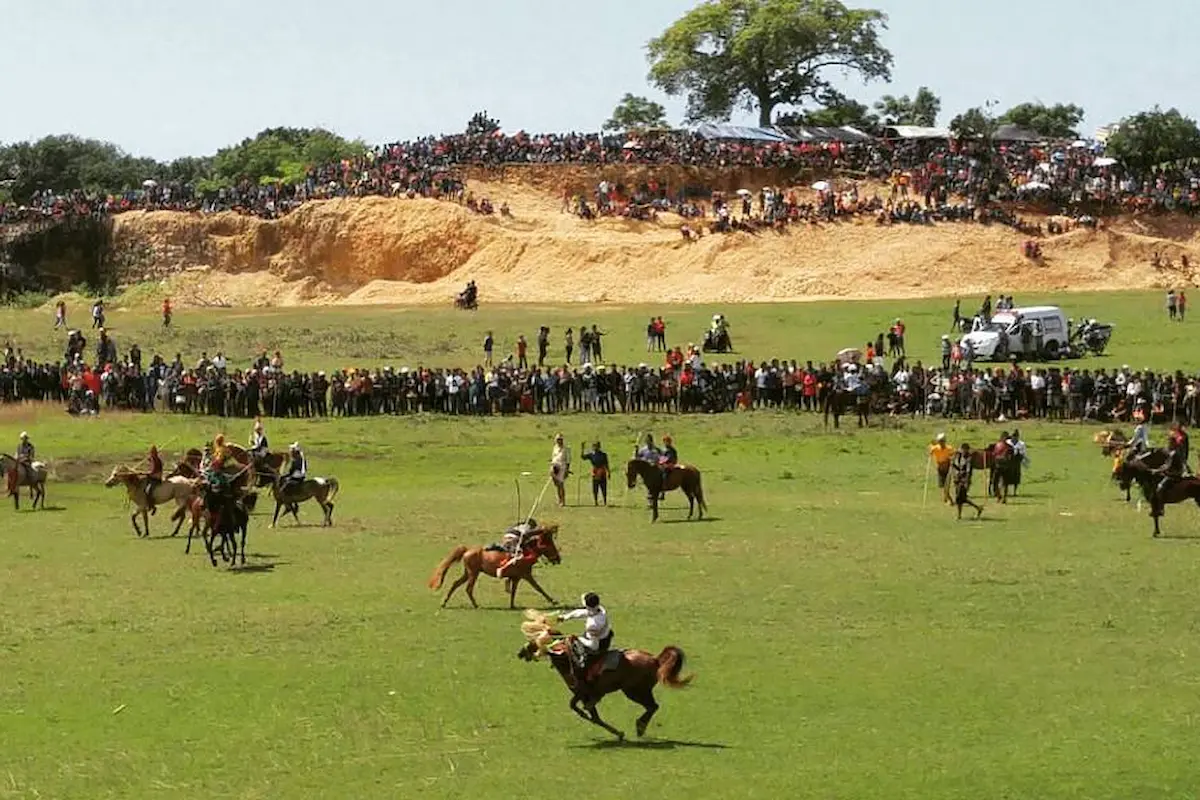
Photo: @sumba_tourism/Instagram
Pasola Festival is a sacred tradition that marks the beginning of the harvest season in Sumba. This event features two teams of warriors riding bareback across open fields to engage in ceremonial combats using wooden spears.
The fight itself represents the importance of honor, reconciliation, and harmony. It is also seen as a way to foster balance between the physical and spiritual worlds–ensuring a prosperous harvest and safeguarding the villages from misfortune. While bloodshed is seen as a good omen–a sign of fertility and renewal–blunted spears are used instead to prevent injuries.
For those interested in seeing this Sumba culture, make sure to wait for the official announcement. Pasola Festival takes place annually between February and March with no fixed dates in Kodi, Lamboya, Gaura, and Wanukaka. The timing is determined by the arrival of sacred sea worms (Nyale), so once the worms appear, the priests can finally set the date.
Also read: Travel Guide from Bali to Sumba: All You Need to Know
2. Megalithic Tradition
Sumba is known for its megalithic tombs, called “Batu Kubur”, scattered throughout its traditional villages. These tombs are not merely final resting places for the deceased, but also living monuments that reflect their socioeconomic status and religious beliefs.
Even in today’s fast-paced world, this tradition continues. As a reminder of how closely their daily lives are tied to ancestry, Marapu followers practice a stone-pulling ceremony. The graves are generally located in front of the house to make it easier for them to send prayers and offerings to ancestral spirits.
The stones used are in different sizes and shapes–a few meters to several tens of meters, round, rectangular, and even house-like. What makes them even more fascinating is that the stones incorporate intricate carvings of humans and animals that hold symbolic meaning.
The building construction itself is quite complicated and requires a meticulous workmanship technique as well as careful preparation. As the stones to be pulled are very large and heavy, logs of varying diameters are laid along the path to the graves. Waikabubak, Praijing, and Tarung Village are the best places for those who want to experience this Sumba culture.
Also read: Best Time to Visit Sumba Island: Discovering Unspoiled Beauty
3. Uma Mbatangu
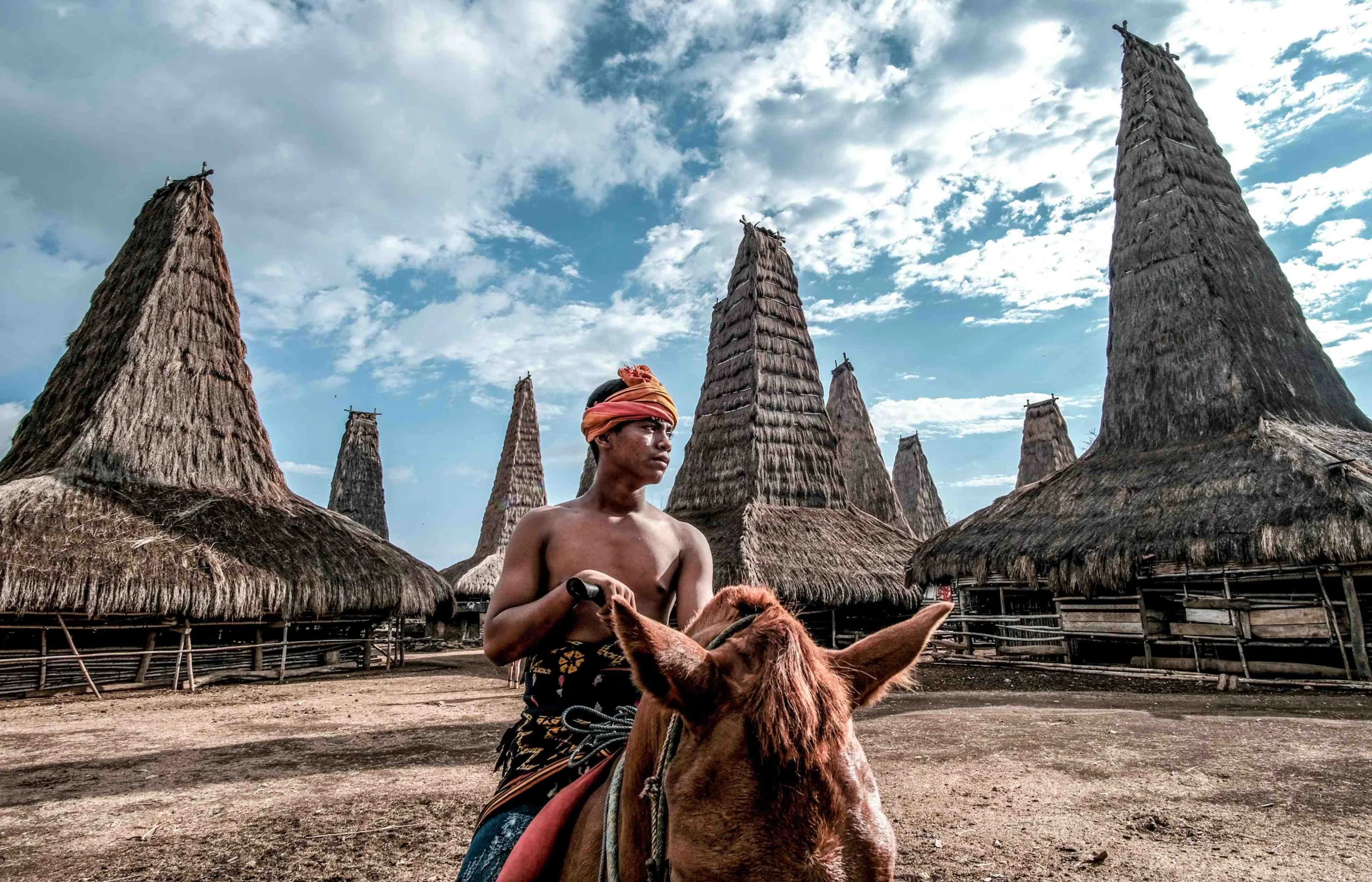
Photo: Indonesia.go.id
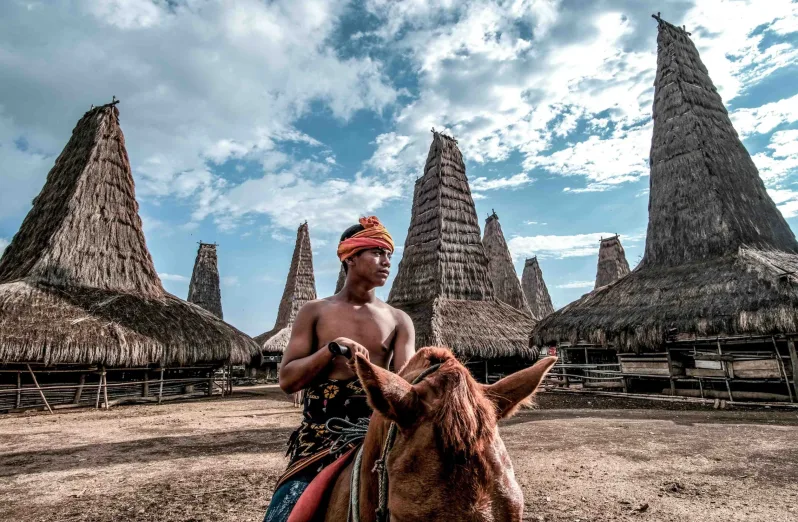
Upon arriving in Sumba, you will be surrounded by beauty and cultural immersion, including the island’s traditional house, Uma Mbatangu. These houses are stunning with their high thatched roof peeking over the horizon.
Built according to the Marapu belief using wood, bamboo, and thatch, Uma Mbatangu is elevated on stilts and consists of three levels. Each level serves a distinct purpose:
- The lowest level: used for the animals and representing the underworld
- The middle level: the human world, where daily activities take place
- The top level: the spiritual world, to honor the gods and ancestors, and also used to keep sacred objects and sacrifices
To them, the house is like a bridge because the higher the roof, the closer they are to God. The buffalo horn-like roofs also reflect a deep connection between the living, nature, and their spiritual heritage.
In addition to that, the houses are divided into three sections, including the sleeping, living, and kitchen areas. Visitors are not allowed to enter the house, and the villagers still perform rituals to protect them against theft.
If your visit coincides with a new house building, you can see that the entire construction is a communal effort. The construction is often accompanied by rituals and mutual support in which women cook in an open-air kitchen while men do the construction.
Also read: 17 Unforgettable Things to Do in Sumba Island
Experience a Lovely Stay at Bobocabin Umarato Sumba!
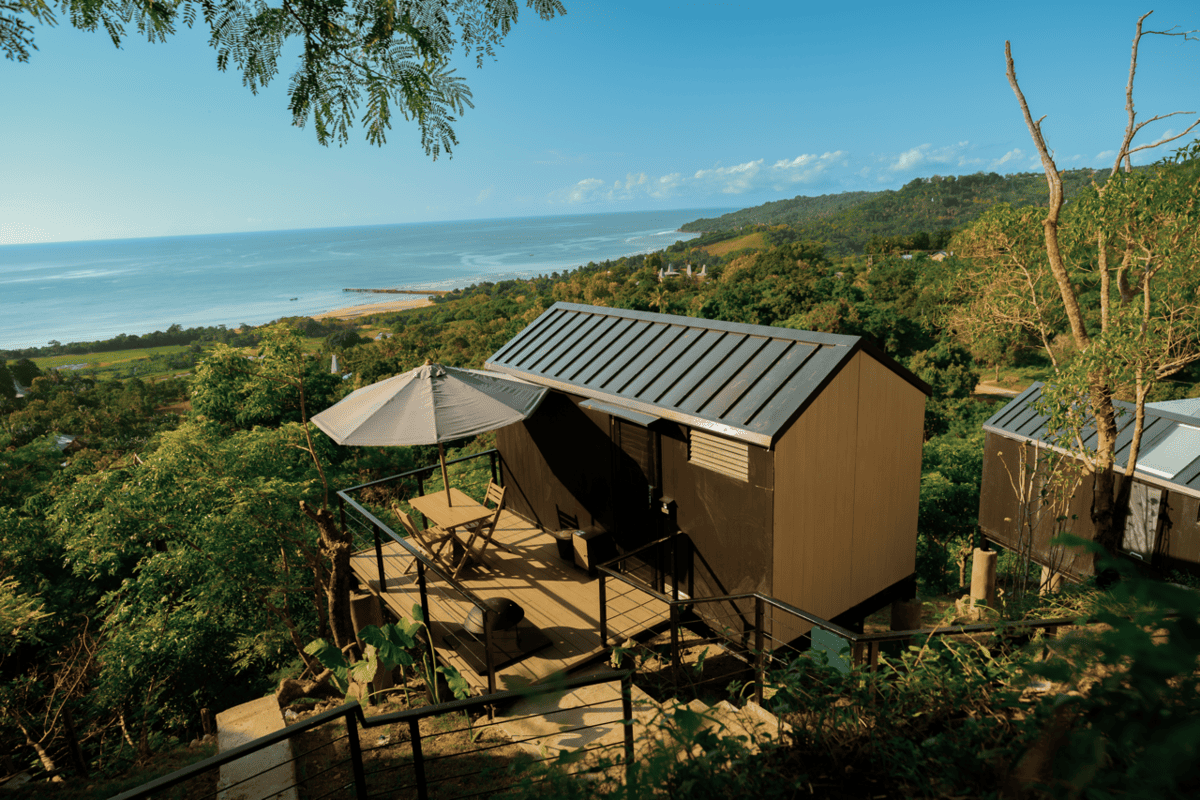
Photo: Bobobox Internal Asset
Are you a beach person? Then, Bobocabin Umarato Sumba is the best place for you!
The cabins are nestled on a picturesque hilltop not far from Rua Beach, so you are guaranteed some amazing views and the soothing sounds of the waves and the birds. Plus, each cabin comes with a high-quality bed, smart window, mood lamp, built-in Bluetooth speaker, private bathroom, and Wi-FI.
What makes Bobocabin Umarato stand out even more is its prime location–making it a perfect base for attending the Pasola Festival and offering easy access to some of Sumba’s traditional villages. All in all, it’s definitely a lovely place to stay.
Download the Bobobox app to book your cabin and let Bobocabin be your perfect base to explore all that Sumba has to offer!
Featured photo: Indonesia.go.id